My Blog List

Saturday, March 31, 2012

Tom Meade Update: April 2012 -Part 5

 February in Norway en route to Modena


“I learned electronics in the navy, on North Island, San Diego, my home base. I also went through bootcamp there. As an aircraft electronics engineer, I served for four years on aircraft carriers: two years on the Oriskany, and two years on the Yorktown.


“With my Merchant Marines/Navy I.D., they told me all the freighters leaving from California went to the far East, and that the closest port with passage to Europe was in New Orleans. So I left Newport Beach, California, and hitchhiked, bound for the port at New Orleans with 50 bucks in my pocket. While still in California I was picked up by an Australian, a plumber. Having lived and gone to school in Australia before, he and I hit it off well and became fast friends.

“We both headed straight to New Orleans and got an apartment together in the French Quarter off Bourbon Street, during Mardi Gras. While staying there, there was a break in to our apartment. But it was the police who broke in –breaking down the front door without a warrant, guns drawn. It scared the hell out of us. After scaring us half to death they realized they were looking for someone else.

“After the time in the French Quarter, I found a freighter shipping out of the Port of New Orleans, the SS Nardo, a Norwegian grain freighter. As a mess hall boy, I landed in Stavanger, Norway. And I was sick for the entire 35 days onboard, which was strange. Of the four years I was in the navy I never got seasick. So in order to function I had to make myself throw up before serving food. After a while, of throwing up so often, there was only green bile coming up. Their remedy was a suppository up your butt. But I didn’t do it. It was unappealing to me. But I did feel better in a prone position.

“With the dry heaves, in order to have something to throw up, I had to eat crackers. That was the only way to cope, as the Norwegians do not consider seasickness as an excuse to not perform duties. The way the freighter tossed and rolled, I didn’t know my name anymore. The Norwegians also loved blood pudding, a jello-like serving of fish blood. It stunk and was nauseating. It only helped me to throw up.

“The Norwegians onboard would also be constantly painting the ship with this anti-corrosion silver paint. And it would get everywhere, including the smell. They would go directly from painting to eating. They had paint all over their hands and it wound up on the dishes and silverware. So they would end up eating paint, literally. Already nauseated, I avoided the contaminated dishware as much as possible.

“So immediately upon leaving the shores of America, and with the immediate onset of nausea at sea, I had to adapt to unfamiliar conditions, which is something I have had to do ever since. But the overseas passage seemed endless. As they paid me a seaman’s salary, I earned only very little money at sea. When the Nardo finally arrived at port it was in the dead of winter. 


“From Stavanger, I resumed my hitchhiking towards Oslo. All was quiet. I stayed on the highway for hours, and it was completely desolate. A car passed once every four or five hours. The ice must have been at least two feet deep. Eventually, I was picked up by a farmer driving an old rickety pickup truck. Speaking no English, he kindly shared his cheese with me. It was clear later that the people in this region had never seen a foreigner before, as if I was from outer space. As he dropped me off in the middle of nowhere, north of Stavanger, south of Oslo, I was wearing a flimsy California cotton jacket, with a short-sleeved shirt underneath. But I never felt cold. I was so excited to be in Europe.


“I recall the beauty of the fjords among a freezing placid lake. It was like being dropped right in the middle of Lord of the Rings. Completely alone, I could hear goat’s bells and heard hawks screaming as they floated through the air down the fjord, flying over the water. This was all before I did or knew anything to do with Modena. I had no money, no knowledge of mechanics or cars, no family, no backup, nobody to help me. And I knew no one. Italy was a foreign place and I had never been there or even to Europe. I could not speak Italian but was leaving for Italy. It was my ‘mission impossible,’ with the future ahead of me. And still it was very exciting in the midst of it all.

“But I knew one thing: I had to own a Ferrari or Maserati, with everyone saying ‘you’re a crazy man, you don’t have any money, that’s impossible’ –naysayers. If they can’t do it then they don’t want you do it.

“I ended up as an actor in Rome for Dino De Laurentiis with David Niven (a famous English actor), and Alberto Sordi. I slept under woodpiles in my sleeping bag when I arrived in Modena. I had no money for a hotel or pensione. People said ‘you’ll never be able to do it.’ That only made me more determined to succeed." 

Friday, March 30, 2012

Ferrari Design Overtones: Going, Going, Gone Asian? Part 2

Seeing Red
(Continued from part 1) And from the same site, http://www.ferrari.com/, the modern Breadvan-esque/station wagon/"shooting brake" FF is a clear Asiatic success story: 
"The FF conquers Asia. Ferrari’s new four-seater four-wheel drive car unveiled at the Shanghai Show by Ferrari CEO Amedeo Felisa and Felipe Massa.
"Shanghai, 19 April, 2011 – The FF is enjoying huge success on the Asian market having already won over a plethora of clients in the Far East. The new car made its official debut in the Asia-Pacific region today at the Shanghai Show where it was unveiled by Prancing Horse CEO Amedeo Felisa and Scuderia Ferrari Marlboro driver Felipe Massa. The latter couldn’t hide his delight with Maranello’s latest creation: 'I’m very pleased to be here in Shanghai for the presentation of the FF,' he told journalists.
“It’s a car I like very much indeed: the perfect combination of performance and usability. I have a son who’s just over a year old now, and this is a Ferrari that you can use with the family without having to compromise on the driving pleasure that only our cars can deliver.' Massa also went on to emphasise the very special relationship between Ferrari and China: 'I was very impressed by the warmth and passion that the Chinese have for the Ferrari brand –that’s also something I’ve seen every time we come here to race, in fact.' 

"For his part, Amedeo Felisa spoke about the growing importance of the Chinese market to Ferrari: 'Last year, we broke all previous records by reaching the 300-car mark,' he said of the company’s sales there. 'In 2011, we intend to continue to grow by at least 30% and exceed the 400-car threshold. I am convinced that the Greater China area will be our second largest market by the end of this year.” 

And initially panned by Ferrari fans as a "woman's car" (which it may be), the so-called F149, aka, Ferrari California, with its contemporary 458 Italia and FF companions, are apparently hot topics in the land of the red: 
"Ferrari’s Chinese market has been growing strongly since 2004. Sales have been excellent across the entire range, but the 8-cylinder Ferrari California and the 458 Italia have performed particularly well. In previews, our Chinese clients were greatly impressed by the technological innovations offered by the FF as well as the generous size of its four comfortable seats and roomy boot (the capacity of the latter can extended up to 800 litres)."
Ferrari F12 Nissan GT-R
For me the F12 reveals a generally pleasing form with more than quite a few moments of gorgeous design throughout the body. It carries the elegance and poise that a Ferrari V12 GT berlinetta should. There is a lushness there with just enough edginess. On that point, at first glance, I don't want to think about Japan when enjoying highbrow Italian cuisine. And I certainly don't want to think about Chinese takeout and volume selling. Although each cultural texture has its place, I want the bottle of fine Italian wine to go to my head, to imbue me with passion. At such a price point, too, a Ferrari V12 GT should produce this intoxicating effect immediately. And the first impression of the F12 nearly does. 
Initially, the unveiling of F12's front end appointments appeared a little strange. But, as was the case with the 458 Italia (and Nissan GT-R), eventually the new child-of-the-wind-tunnel design idiom began growing on me. The contemporary Ferrari face with the elongated "bioluminescent," deep-sea-creature-like headlamps, running up the top sides of the car, and the "Chevron Cars" cartoonish grille --have presented themselves as decadal identifiers. Hence, this is what Ferrari looks like today. 
And as with the severe Ferrari Enzo (and in some of the aforementioned newer Ferraris), the Nissan GT-R can elicit a polarizing effect upon the beholder: It is either hideous or brutishly attractive, at very least an acquired taste for the enthusiast not already well-adapted to Japanese tuner culture. Form following function doesn't have to be ugly but in some cases it is. 
When a car can slice through the air, shift, corner, in fractions of a second quicker than a competitor, engineering will begin to dictate what beauty and "passion" are allowed to be. It is evident, too, that when such results render less-than-attractive design cues, then the policy is to feature such appointments. Why try to hide them when they can be exaggerated and passed off as being state-of-the-art?  
Familiar with Japanese tuner/enthusiast culture myself, I could not help but to see the Nissan GT-R discreetly whispering over the form of the F12. Certainly, Ken Okuyama has been long gone from the midst of Pininfarina's corridors of power and had nothing to do with GT-R development. So is this mere coincidence or is there an airborne Asian car virus sprinkling dust over Maranello?

part 3 here: http://chadglass.blogspot.com/2012/04/ferrari-design-overtones-going-going.html

Wednesday, March 28, 2012

Ferrari Testarossa (1984-1996): Tame Design in Hindsight?


Considering the current decadal design idiom of the latest offerings of Montezemolo-era cars (FF, F12, Italia, to name some), is the Ferrari Testarossa, 512TR, and 512M, of 1984-1996, a relatively tame design platform in hindsight? Are the side strakes really such purveyors of extravagance and flamboyance? 


To backtrack into some context briefly, in 1982 Pininfarina was commissioned to style a 12-cylinder Ferrari with radiators in the flanks like a racing car, with GT-level luggage and storage space, user comfort, and top-tier Ferrari performance and image. The Testarossa was among the first Ferraris to be shaped partly by the wind tunnel to enhance aerodynamics, promote low cabin noise, and increase high speed stability.


Rear location of the radiators made the car's aerodynamics even more important as passive direction of air to and from the engine bay had to be very effective. In achieving this feat, Pininfarina's design and engineering of the Testarossa project became, seemingly overnight, the most recognizable and influential car of a generation. It became, as in the Lamborghini Countach, the unequivocal exotic dream car to have. On posters affixed across the world, in the rooms and garages of kids and adult children alike, the Ferrari Testarossa is unmistakable, bold, and impossible to ignore, cherished to this day by a devoted cult.


Of note, the Testarossa's roofline exactly matches that of the straked flank below it. And with the traditional Ferrari identifiers present (such as the egg crate grille, recessed headlamps of the era), the new elements (such as rectangular rear lights and the broad, squared, rear flanks) mark a bit of a departure. Early Testarossas feature a single mirror located halfway up the driver's side A-pillar, on stalks. But clearly the Testarossa's most defining and controversial image is that of the five body strakes that cover the side intakes and stretch between the ridges just below the door mirrors. Today most, or at least many, Ferrari fans regard these as extreme design aesthetics, dated, even hideous. But is this necessarily really true? 


Individual tastes and perceptions notwithstanding, is the Ferrari Testarossa, 512TR, and 512M, made from 1984 through 1996, respectively, actually a tame (even tasteful) design in hindsight? Are the side strakes really that outlandish compared to the more recent 458 Italia's bizarre front end? Or to the new F12's strange cartoonish front fascia? Or what about the FF, with it's entirely non-confomist Breadvan shape, with similarly strange front end? Do these design showboats, Italia, F12, FF, boast restraint --or do they go beyond what one would consider to be in good taste? 


By comparison, is not the Testarossa quite conservative and understated, being a basically squarish wedge design with retractable headlamps? Save for the wide track and strakes, Ferraris had become what the TR represented at the time, with the 348 and 355 following in its shadow. It would seem that the front end of any TR, particularly the non "M" version, can actuality pass for austere and tastefully restrained. One could even say it appears "normal," in its design idiom of the time. But yet it is forever "outrageous." 


In a strange twist of fate, perhaps it is the time that the TR was trapped in, when new, which forever entraps it into its continual stigma of being the gauche, strake-riddled, testa rossa/red-headed stepchild today. Alas, I tip my hat and embrace Testarossa, the black sheep that it is for so many Ferraristi

Friday, March 23, 2012

Ferrari Design Overtones: Going, Going, Gone Asian? Part 1

(photo illustration by Chad Glass)
With the demise of the traditional family-owned Italian cultural design mainstay Pininfarina, will Ferrari increasingly slide into the hands of Asian design aesthetics, blowing in the wind of market forces and banking dictates? Has the Ferrari/Fiat/Italian identity already been usurped by an increasing economic force guided by the likes of Japan and China? 

Rewind a decade to the Enzo supercar and Ken Okuyama, Pininfarina's chief designer at the time. In addition to designing for Porsche and Maserati, Okuyama's creative direction heralded a different direction in Ferrari aesthetic. Although brief in involvement with Pininfarina before being booted out, Okuyama's Enzo became the poster child "Lamborghini Countach" of its generation. For those so captivated then and today by the Enzo's Italian centerfold/fantasy dream car appearance, such affection and support exists for a Japanese-inspired form. Alas, the Land of the Rising Sun appears setting all over the carbon fiber, the Enzo a form following function. 


Your personal taste notwithstanding, the red car (including the 612 Scaglietti also designed by Okuyama) may be taking on a new meaning: Has Pininfarina's direction been forever infiltrated, skewed to Asian/global sensibilities, even if subconsciously? 

To illustrate the story further, here is an example of recent market conditions from http://www.ferrari.com/Maranello, 27th July, 2011:


"Ferrari celebrates best six months in its history in terms of revenues (+19.6%) and cars delivered 3,577 (+11.8%). Net profits of 91.8 million Euros (+23.5%). Record industrial net cash of over 650 million Euros. Exceptional results in the USA (+23%) with China (+116%) now second largest market...

"With regard to sales, North America maintained its position as Ferrari's no. 1 market with 939 vehicles delivered during the six-month period, an unprecedented leap of 23.2% vs. 2010. Volumes were also higher in the Greater China region (Mainland China, Hong Kong and Taiwan) with 378 vehicles delivered in the first six months (+116% vs. 2010). This performance means that the main Asian market is now Ferrari’s second largest worldwide, overtaking Germany where volumes remained the same as last year with 337 cars delivered."
(Continues in part 2)

Tuesday, March 6, 2012

Tom Meade Update: March 2012 -Part 4


Metal Crafters and John Gaffoglio

“John Gaffoglio, Argentinian founder of Metal Crafters of Orange County, California, is one of my best friends. He would make prototypes for Chrysler, Porsche, Mercedes, Bentley, Rolls Royce. He worked on the Chrysler Thunderbolt, Plymouth Prowler, and Dodge Viper, to name a few. He has done one-offs for the Sultan of Brunei (Bentley and Rolls).

“Gaffoglio has since retired and moved back to Argentina. His three sons now run Metal Crafters out of Fountain Valley. I recall they did a concept “hot rod” car a while back for Chip Foose and it ended up not quite how they had intended.

“In the early ‘70s, a classic car collector named Tony Carlini was meeting with Iacoca one night. Carlini said ‘I have a guy who’s a genius at metal work and making prototypes.’ That same night he took Iacoca to see Gaffoglio. What resulted was an overnight deal between Gaffoglio and Iacoca to financially setup Metal Crafters, to build prototypes for Chrysler.

“In the 1980s, Gaffoglio would visit and stay over at my place in Milano when he had any business in Italy. And Iacoca had a villa in Tuscany outside of Florence. At the time, John was looking for Italian windshield glassmaking machinery. I would help him locate the parts.”


Ferrari GTOs


(above: Ferrari 250 GTO #3647 at 2008 Lime Rock Historics: This is the only 250 GTO that is still unrestored)

“I had a Series III, Ferrari GTO #4091. Today Peter Sachs, grandson of Harry Sachs of the Goldman/Sachs banking dynasty, owns it in Connecticut. I had a typo 64 LM roof GTO as a daily driver in Modena, and I had fastback GTO #3647 which I sold to Mr. Saurs, who lives on the east coast, for $5500 after originally paying about $900 for it, worth about $35 million today."

According to Tom: “It is commonly misunderstood and misrepresented in modern automotive literature as to the designation of series types of the GTOs. In common error, the auto journalist will refer the 250 GTO as being of two types, the so-called ‘Series I’ and ‘Series II’ body styles. This is inaccurate. Back in Modena they were not differentiated by only their body styles. You have to look at both the body style and the number of vents on the front sides.

“A Series I GTO will have the original body style that debuted in 1961, and will have two vent slots on each side of the front quarter. A Series II GTO, of 1962, continues the 1961 body style but has three vents on each side. A Series III GTO, the ‘250 GTO/64,’ of 1964, has three vents and a totally different body and LM style roofline.

“You can see clearly that GM took the design elements of both styles of the Ferrari GTO and directly applied them to the Corvettes of the 1970s and early ‘80s.”


Chassis Heist

“While in hospital about two years ago I had 4 valuable Ferrari chassis stolen.  They are as follows:

·      1960 250 PF Coupe: SN 1847
·      1964 250 GT Lusso: SN 2917
·      1966 275 GTS, 2-cam: SN 08653 --owned by Steve McQueen, #200 of 200 built
·      1969 365 GT 2+2: SN [N/A] –4 suspension corners intact, complete with steering and pedals

“I’m presently seeking their recovery and will offer a great reward. Anyone with any information about the chassis can email at: tommeadecars@gmail.com

“I was going to rebody them as they were nude chassis,’ as I have all of the mechanical parts and components for reassembly. You can see what Steve McQueens’ 1966 275 GTS looked like when he had it, on page 41, in the book ‘McQueen’s Machines’ by Matt Stone.” It’s also in Hillary Raab Jr.’s Ferrari Serial Numbers, Part 1.”


(above: Steve McQueen’s 275 GTS 4 NART Spider)

Inventors, Journalists, and Madmen

“In 1996 Marc Sonnery did an interview with me in Santa Monica but did not cover most of this as we just ran out of time after five hours. I’m glad Chad Glass is covering this material today, most of it untold (as of this writing). And I want to recommend another book, The Golden Age of the American Racing Car by Griffith Borgeson, another good friend of mine (and regarded as the greatest automotive writer in all history). With his wife, Jasmine, Borgeson lived in Aix-en-Provence, near Côte d'Azur, the French Riviera, one of the most beautiful places in France. When in Italy, he would sleep over at my house. He wrote a feature article about me in 1971 for Motor Trend.

“But about Borgeson’s book: Harry Miller stands as the central figure. In my estimation, he was a mega genius, my hero, and the God of American racing cars. You could say that he was the Nikola Tesla of race car design.

“At his workshop, in Culver City, California, Miller “reinvented” the overhead cam, the multi-valve engine, putting them on the map. And he built his own cars to boot. As early as the 1920s he was building V12s using 4 valves per cylinder. He got the attention of Ettore Bugatti when he raced his Millers in Europe. In 1955 Griffith flew to France and bought the two Miller cars that Bugatti had bought from Miller, years before, in order to copy the overhead cam designs --Bugatti literally ripped off Miller’s designs. But despite these historical firsts, his enormous gifts and achievements, he died penniless in a hotel room –he was too ahead of his time, which created a living hell for himself.

(below: 1922 HCS Special Miller)


 “Leo Gossen, his German engineer, developed Miller’s ideas into reality. In the 1930s Bugatti bought 2 of Miller’s cars and copied the overhead cam designs. It is well documented by Borgeson. And his journalistic successor, Karl Ludvigsen, sort of picks up where Borgeson leaves off. Ludvigsen, from Michigan, is the most technical auto journalist that I know of. He is, to the best of my estimation, without peers in his sphere of expertise. He went to MIT and writes about cars like an engineer.”

People continue shuffling by as Tom and I have our coffee. And that name stays with me: Ludvigsen --seems to ring a bell. I look up and take pause. As if caught trying to recollect a dream, I have a picture in my mind of a book that I have. It’s a heavy book, not light reading. And I’m nearly certain it is what I think it is.

So long after our meeting, back at home, I reminded myself to go to the spot I was envisioning, to get the book, and look at the cover. And as I expected, upon scanning the shelves, I recognized the title on the spine and it just said The V12 Engine. That’s the book. I then took it off the shelf and scanned down to look at the author. And lo and behold, there printed was: “Karl Ludvigsen.” I can say the book is quite dense and packed with history.

As visions and sounds of V12s from a bygone era echo away from my mental snapshots I am taken back to the present as Tom is continuing:

“Another influence on me, Michael Parkes, was a Formula 1 Ferrari driver and suspension engineer. He drove for Scuderia Ferrari from 1962-67. He joined them in 1963 as a test and development engineer. He was promoted to the F1 team, as driver, after John Surtees left, just before the 1966 Le Mans race. He would bring his personal Ferrari, a 275 GTB, into my shop in the Via Piazza, and work on it. It is from Parkes where I learned about suspension engineering theory. He was killed in a Lancia Stratos at age 46.

“Speaking of John Surtees, his teammate, Lorenzo Bandini (who in 1966 became Ferrari’s number one driver), was killed in an F1 Ferrari at the Monte Carlo Gran Prix, 1967.”

Friday, March 2, 2012

Cult of Tacky: Perfectly Good GTOs Destroyed for Monkee Business


("Monkee Mobile," designed, crafted, and butchered from a perfectly good Ponitiac GTO) 

The sadness, tragedy, and untimely death of pop icon Davy Jones aside, we inevitably must get back on track, look forward, and come around to thinking about cars again. Whereas the 1960s television series The Monkees had its host of hip characters and props, the standout item of interest clearly points to the Monkeemobile: A tacky, tasteless, and generally ridicuolous looking cartoon car that "won," as perfectly good Pontiac GTOs were destroyed for the sake of Monkee business, with business emphasized. Hence, in context of the time and the cultural aesthetic established within the show, cult of celebrity and branding trumped good design. As in the case of the Batmobile, a mascot car for the Monkees made sense and seemed to fit, the massive success of the franchise being self-evident. 


Micky Dolenz, Davy Jones, Peter Tork, and Mike Nesmith found fame in the 1960s with their eponymous television show The Monkees, and went on to sell more than 50 million records. The band split up in 1971 but has reformed several times since. Their popular TV show ran from Sept. 12, 1966, to March 25, 1968, with 58 episodes. The show, inspired by the Beatles’ movie A Hard Day’s Night, won two Emmy Awards.


(The Monkees in their heyday: Micky Dolenz, Davy Jones, Peter Tork, and Mike Nesmith)

Whatever one's opinion of The Monkees may be, including the car, at their peak in  popularity, in 1967, they were outselling the Beatles and the Rolling Stones combined in the United StatesI’m a Believer, written by Neil Diamond, remained at No. 1 on the Billboard charts for seven weeks. Diamond also wrote A Little Bit Me, a Little Bit You, which reached No. 2. The Monkees had six top-10 hits, including three No. 1 hits: Last Train to Clarksville, I’m a Believer and Daydream Believer.


After the Monkees, Mr. Nesmith became the creator and chief executive officer of Pacific Arts, a successful video production company that made some of the first music videos. Nesmith pitched the idea of a 24-hour music-video channel and sold the idea to Warner, which developed it into MTV. His video Cruisin’ was one of the first MTV played. Nesmith often is called the “inventor” or “stepfather” of MTV.


With such innovation, perhaps the "Last Train to Destroying GTO-ville" was for the good. Although not a particularly rare car for the time, the GTO was clearly at the forefront of American design aesthetic and a leader in the muscle car revolution, a child of the 1960s. So, too, the Monkees became a major influence in the fabric of 1960s American pop culture, undoubtedly helped along, in part, by the implementation of the Monkeemobile as an integral element in many of the television episodes. At the leading edge, television, the Pontiac GTO, the American muscle car, and the British Invasion all clashed in harmonious tastelessness and fun. Some forty years on, The Monkees, today, are forever carved in stone and guaranteed a place in history, in memoriam.


The Monkeemobile's origins began when Dean Jeffries, and his sidekick Dick Dean, were asked to design and build a car for a new TV show called "The Monkees". Dean, who was under contract with Model Products Corporation (MPC), told CEO George Toteff about the project. A make of vehicle had not yet been chosen for the project. Mr. Toteff then told his friend Jim Wangers of these developments. 


(Jim Wangers, the man most closely associated with the advertising and promotion of Pontiac during the glory days of the 60s and 70s, the man affectionately termed, the "Godfather of the GTO")

Mr. Wangers was working with Pontiac promotion and advertising at the time and saw the show as a huge promotional opportunity for Pontiac. After making the deal, Mr. Wangers supplied two base 389 4-barrel 1966 GTO convertibles with automatic-transmissions to be converted into Monkeemobiles. MPC was in turn given exclusive rights to market a model kit of the Monkeemobile. They would end up selling over 7 million copies of these kits.


Two cars were built for the NBC TV show The Monkees in the span of 4 weeks: Car #1 to be used mostly for the TV show, and Car #2 to be used as a stunt car but used on the promo/touring circuit. Both cars were base-engine 389 four-barrels with automatic transmissions, were originally silver/blue metalic in color, and each would end up being used in the TV series (as an example; Car #1 in episode 33 and #2 in episode 39).


Car #1 has a larger door logo, different color blower flaps (blacked out) and different belt cover than the #2 which has the smaller logo and red colored flaps, the belt cover ribs farther apart. Both measure around 20 feet long. Stewart Warner gauges fill up the dash. Permanent hardtop was built to resemble a convertible top and covered in tan orlon to match the tan vinyl upholstry. Two people could unbolt the top and lift it off the car. Outside the car, all chrome was removed including door handles. Front and rear sheet metal was hand formed by Dean Jeffries and Dick Dean. No fiberglass was used. 


Square CIBIE headlights brought over from France were used in front. Taillight covers frabricated especially for the car were used over factory assembly. Thirty coats of Candy Wine Burgundy paint were laid on and hand rubbed. The car rests on Goodyear 900x15 tires in the rear and Goodyear 650x15's in the front. Crager SS wheels with center knock-off caps lay inside the tires. Power comes from a 389 cubic inch Pontiac engine. Dummy blower set up is used to cover carbs. Rear axle is solidly mounted.


(Monkeemobile, early concept drawing for modified GTO)

Factory windshield was cut and tilted forward and a chrome piece was added to the center to give the illusion of a taller split windshield. The aft portion of the front wheel wells were lengthened to allow the non-functional chrome exhaust trumpets to protrude. Functional exhaust exits are located just ahead of the rear wheels. 


A trailer hitch was added to the car with the intention of pulling a trailer that would open up so that the band could perform on it. Even though the trailer was built, it was never used in the show. The hitch was later removed. Car #1 was taken to Australia to help with promotions on the 1968 Monkees concert tour. For some reason, the car did not travel on with the tour and was left there. Dean Jeffries made the attempt to retrieve the car but was unsuccessful.


The car would later appear in Puerto Rico as a hotel courtesy car. It is still a mystery on how it ended up there. In 1992, it would sell at government auction for $5,000 when the hotel went out of business. Car #1 is now in the safe hands of a private collector on the East coast. Car #1 can be seen from time to time at collector shows. Car #1 was used for the 1/18 scale diecast (note the use of the door logo which is reversed on the right door). Car #1 was used in 1997 for the Monkees TV special and on display in 2001 for the Petersen Automotive Museum "Cars And Guitars Of Rock & Roll" exhibit. 


(George Barris and adoring fan with the Monkeemobile)

Car #2 was acquired by George Barris at end of The Monkees TV series after Dean Jeffries declined to purchase the cars back from NBC. Car #2 was auctioned off in September of 1983 for $26,000. The winning bidder never appeared to pay for the car. Car #2 was used as part of the TV Land display. Car #2 was seen in the "She's gotta have it" episode of the TV show Wings along with Peter Tork. Car #2 was fully restored & modernized by Mike Gray and his team in 2006 for the 40th Anniversary of The Monkees.


Car #2 was auctioned off by George Barris through Barrett-Jackson on January 19, 2008 for the winning bid of $360,000. This car is now owned by a private individual in southeast Michigan. Of course these Pontiac GTOs, #1 and #2, were at once destroyed but consequently immortalized, catapulted to a fame and exposure never to be seen had they remained unmolested. Alas, "The Monkees" were a cartoon and parody/marketing force directly drawing from the Beatles phenomenon. As the Monkees were selling more records than the Beatles, seemingly impossible, so, too, can public tastes often mirror such illogic; hence, the butchered cartoon car Monkeemobile --where tasteless, tacky, timing, and opportunity trump good design. Jim Wangers couldn't agree more.    

Thursday, February 23, 2012

Renedezvous Redux? Reflections on Claude Lelouch


Written by Stephen Mitchell, Artwork by Chad Glass
French Translation follows English text

When Stephen Mitchell was recently introduced to VeloceToday by Wallace Wyss, he told us a bit about himself, mentioning Ferrari, film making, and Paris. We added this up and asked him his thoughts on, of course, Claude Lelouch’s film ‘Rendezvous’. Bingo!! We pressed the right button.

Mitchell was born and raised to have a Hollywood career–literally. A native of Los Angeles, he studied sound, cinematography and editing with department heads from CBS Cinema Center in Studio City, California where Steve McQueen had his Solar Productions. Working as an extra and in small speaking parts in Hollywood films, he practically lived on the set of the television series Mission: Impossible as a family friend directed many of the show’s episodes. Obviously a film career was in the making, but instead of Hollywood, Mitchell’s film career began in France. “I went to Paris because I saw a film by Claude Lelouch—“A Man and a Woman”. It showed me exactly the kind of film I wanted to be making and it wasn’t happening in Hollywood.” We’ll let Mitchell take it from here…
While my interest in films was already well established, strangely enough my passion for cars took root while I was recovering from a head-on collision on the Ventura Freeway. I wasn’t expected to live through the first night but, in the end, my father and I both survived. I read one Road & Track magazine after another, learning and becoming excited about Ferraris, Formula One and the incredible collection of personalities that populated those worlds. It was family friend and mentor Paul Stanley, the director who issued a standing invitation to visit the sets he worked on, who told me I should see A Man and a Woman. (1966)It had impressed him and he figured I would like it, too. That was an understatement.
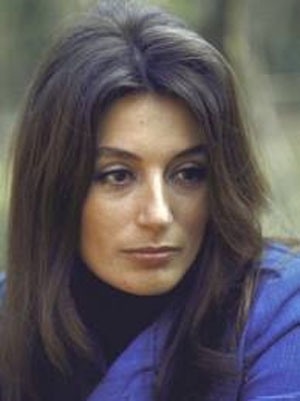
I can’t say what impressed me most about the A Man and a Woman because there was so much hitting me at once. The beautiful Anouk Aimée with her reserved sensuality so different from that of American actresses cast a spell on me that never went away. The scenes of Jean-Louis Trintignant testing the Ford GT40 and the rally Mustang at Montlhéry (where the Ferrari GTO s/n 3987 I would later own won its first race driven by Ricardo and Pedro Rodriguez on October 21 1962) definitely raised my pulse as did the section of the film dealing with the race at Le Mans. Even the hospital scenes resonated for me having “lived’ there for a time not too long before. I loved the scenes of the Monte Carlo Rally.

Anouk in the mid 1960s

A Man and a Woman was the first French film I ever saw though I also liked films like Jean-Luc Godard’sBreathless, Jean-Pierre Melville’s Bob le flambour and Le samouraï along with countless Italian films including Dino Risi’s Il Sorpasso (The Easy Life) and Federico Fellini’s 8½ (Otto e mezzo) which also featured Anouk Aimée. A Man and a Woman was innovative in presenting its story in a non-linear fashion with a mix of color and black and white footage. It was almost a documentary on cars and human relations in the way it came across to me. That film set me on a path to make my own first film years later in France and in French.
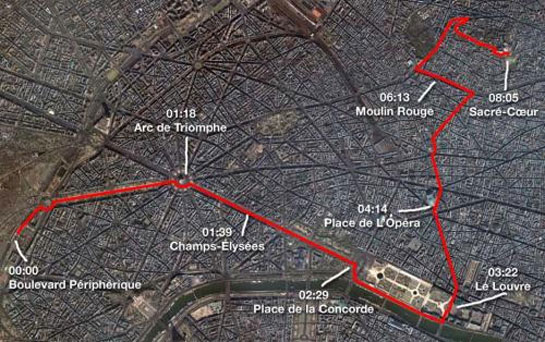
I had made the decision that I wanted to make French films so off I went to France. I wasn’t living in Paris for too long before I was told of a legendary short film shot by Lelouch. Friends in Paris who knew of my fascination with Lelouch and his films asked if I was aware of C’était un rendezvous.Surprised to learn that I hadn’t heard of it, they told me the story. Claude had risen early one morning, attached a movie camera to the front bumper of his car and sped half-way across Paris running red lights, dodging cars and pedestrians and speeding down the Champs-Élysées to finally make his way to the Butte Montmartre where one finds the Basilica of the Sacred Heart. It was an exciting story to hear but it would be many years before I would actually see the film thanks to the Internet and YouTube. Though the film played in cinema houses as a short subject preceding the main presentation, there was no money to be made with Rendezvous. Making it was the act of someone who loved both filmmaking and cars, which describes Lelouch very well. The fact that it also describes me very well was not lost on me.

While living in Paris, I had gotten to know Jean Collomb who was Claude Lelouch’s lighting director on some of his most famous films. Jean was introduced to me by mutual friends and, during the time I lived in Paris, I came to meet many of the people who had worked with Lelouch—Lino Ventura, Françoise Fabian, Philippe Léotard, Charles Gérard, André Dussollier, Philippe Labro, Janine Magnan and Jean Mermet but I never met Lelouch himself. One of the things Jean told me was that Lelouch was not one to apply for shooting permits preferring to just show up and film the scene, the less said the better. This approach went wrong when Lelouch shot a scene on the Champs-Élysées where an actor dressed as a cop is shot and falls to the ground just as a bus load of real CRS riot police drove by (you know, the guys with the machine guns), but that’s a story for another time. All this goes to say that Lelouch did not bother with getting a shooting permit, the obligatory retired traffic cop or any sort of crowd control. This was guerrilla film-making born of the post-war Nouvelle Vague at its best.

Dubbing a Ferrari into the soundtrack of Rendezvous was a stroke of 
genius for it added glamour and mystery. The reality was that a Mercedes similar
 to this one was used to film the run, not a Ferrari.

Lelouch set off in his Mercedes 450 SEL 6.9 on a morning in August 1976. Many–including me–believed, upon seeing the film that Claude was driving a Ferrari but he wasn’t. The belief came about because someone had expertly added and matched the sound of a Ferrari to the film’s soundtrack in post production. The one concession to safety was to position Elie Chouraqui, who worked as Lelouch’s assistant director and later directed his own films, near the guichets du Louvre with a walkie-talkie to warn Lelouch as he was about to cross the rue de Rivoli if there was any traffic. Fortunately there wasn’t, because the batteries on Chouraqui’s radio were dead.

A map of the 'Rendezvous' route found on the Internet.

35mm movie film comes in ten-minute rolls which meant that Lelouch had that much time to get to Montmartre or he would run out of film. At one point, as Lelouch nears Montmartre, he begins a turn into a street that he quickly aborts–a delivery truck was blocking the way and the film would have rolled out. Improvising, Lelouch carried on and took another route past the Cimetière de Montmartre (where I shot scenes for my movie Point of Departure), across the Place du Tertre ending up in front of the Sacre Coeur to meet his date (played by his wife) all before the ten minutes expired.

When the film played in cinema houses to enthusiastic audiences, it came to the attention of the police who summonsed Lelouch to the Préfecture de Police. In his autobiographyItinéraire d’un enfant très gâté (Itinerary of a very spoiled child), Lelouch describes the following exchange with the police official. “Give me your driving license,” Lelouch was ordered. A moment later, it was handed back to him as the official told him, “I promised I would take your license, but I didn’t say for how long,’ adding, “My children love your film.
The one constant in every Lelouch film is the obvious love of film-making. Watching any of Claude’s films, one gets the sense of how much fun he had making them. This was never more evident then with C’était un rendezvous. If you don’t know his work, may I suggest Toute une vie (And Now My Love), L’aventure, c’est l’aventure (Money, Money Money), Les Misérables and Roman de gare (Crossed Tracks). What , A Man and a Woman , C’était un rendezvousand all the other Lelouch films show us is what we go through to find, be and stay with those we love—even risking jail with a high-speed run across Paris.

'Rebel Rebel' author Marc Sonnery, far left, Carrera Panamericana 
co-procucer Jeanetta Dumouchel and Stephen Mitchell next to the 
ex-Mitchell GTO, now owned by Ralph Lauren.

As a filmmaker, Lelouch has had a great influence on me and my own exploits. My late teen years were characterized by a passion for movies and cars—at 16 I bought an E-Type Jaguar, at 17 a Ferrari Berlinetta Lusso and by 18 or so, I was driving a Ferrari GTO. In an earlier harmonic of Rendezvous, I drove my Lusso from Woodland Hills to Las Vegas in two hours, fifty-five minutes though without a camera mounted on the bumper. I raced my GTO on Mulholland with ABC series actor Peter Helm and friends in an episode that was filmed and could have been inspired by Claude Lelouch. My first film was titled—Montmartre—shot in France and in French no less. Extracts of it can be seen on YouTube Watch Montmarte When Lelouch races past La Place du Tertre, I can see where a scene from my Montmartre was shot.


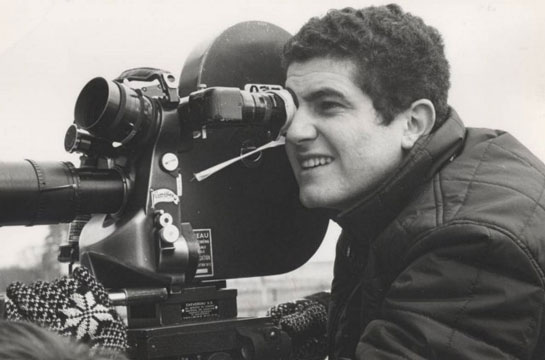
Claude Lelouch in the 1960s. Perhaps he'll take up on Stephen's 
offer to recreate Rendezvous in a Ferrari Italia?
Now almost 75, Claude Lelouch continues to make films in his unique style. I too am still making movies, my last was shot in Paris, Cannes, Milan, Venice (Italy) and Monaco. More recently, I shot a documentary about the original Carrera Panamericana road races run from 1950-54 Watch youtube and I continue to work on a project about the GTO. I was privileged to be a co-producer on Addiction Incorporated, a documentary produced and directed by Charlie Evans Jr. I love documentaries but soon, I will be writing and directing another movie. Paris continues to be my second home and my first love. I was just there after attending the Cannes Film Festival and I am looking into establishing a film school somewhere in France.
As for C’était un rendezvous, today it is more popular than ever—a touchstone for those who love cinema, cars, Paris and adventure. The Internet and venues such as YouTube have given a life to the legend of Rendezvous which will be shared by our children and theirs. It won’t get old; defiance never does and audacity never will.
Could Rendezvous be made today? Yes and no. Yes, we could do it. No, I fear it would not have the same successful result. Surveillance cameras would be onto us before we reached La Place de l’Étoile and a police helicopter would be descending upon us by the time we reached Place de la Concorde.
If the opportunity arose, what car would I choose to make the run? A 458 Italia, I think. I’d love to hear the sound of the tires on those Parisian cobblestones and the echo of the Ferrari’s engine bouncing off the walls of those narrow streets. Imagining how such an adventure might play out, my friend Chad Glass, who did a superb job of illustrating the poster for my documentary Carrera Panamericana (1950-54) has sketched “my” Ferrari 458 Italia as we defy the laws of physics and Parisian traffic in a re-creation of Rendezvous.
Would I really make the attempt? Absolutely and I’d ask Lelouch if he’d like to go along for the ride.
In French
Le retour de « C’était un Rendez-vous? »
Réflexions sur Claude Lelouch
Par Stephen Mitchell
Art par Chad Glass
Serait-il possible de recréer le film mythique de Claude Lelouch, “C’était un rendez-vous»? Le réalisateur Stephen Mitchell utiliserait la nouvelle Italia.
Art original pour VeloceToday par Chad Glass.
Quand Stephen Mitchell a été récemment introduit à la VeloceToday par Wallace Wyss, il nous en a dit un peu plus sur lui-même, mentionné Ferrari, le cinéma, et Paris. Nous avons additionné tout cela et lui avons demandé ses pensées sur, bien sûr, le film de Claude Lelouch « C’était un rendez-vous ». Bingo!! Nous avions appuyé sur le bon bouton.
Mitchell est né et a grandi pour avoir une carrière à Hollywood, littéralement. Originaire de Los Angeles, il a étudié le son, la cinématographie et l’édition avec les chefs de service de CBS Cinema Center à Studio City, en Californie, où Steve McQueen avait sa societé Solar Productions. Travaillant comme figurant et aussi acteur dans des petits rôles parlés pour le cinéma Hollywoodien, il a pratiquement vécu sur le plateau de la série télévisée Mission: Impossible, étant donné qu’un ami de la famille avait dirigé de nombreux épisodes de la série. Bien entendu, une carrière au cinéma était en préparation, mais au lieu d’Hollywood, la carrière filmique de Mitchell a commencé en France. “Je suis allé à Paris parce que j’ai vu le film de Claude Lelouch « Un homme et une femme ». Cela m’a montré exactement le genre de film que je voulais faire et qui ne se faisait pas à Hollywood.” Nous allons laisser Mitchell commencer à partir d’ici …
Alors que mon intérêt pour les films était déjà bien établi, très étrangement ma passion pour les voitures a pris racine lorsque que je me remettais d’une collision frontale arrivée sur l’autoroute Ventura. Je n’étais pas supposé survivre à la première nuit mais, à la fin, mon père et moi avons tous deux survécu. J’ai lu le magazine « Road & Track » l’un après l’autre et devint excité par Ferrari, la Formule Un et l’incroyable collection de personnages qui ont peuplé ces mondes. C’était un ami de la famille et mentor Paul Stanley, réalisateur qui m’a délivré une invitation permanente à visiter ses tournages, qui m’a dit que je devrais aller voir « Un homme et une femme » (1966). Il était impressionné par ce film et a pensé que je l’aimerais également. C’était un euphémisme.
Je ne peux pas dire ce qui m’a le plus impressionné dans « Un homme un et une femme », parce qu’il y avait tant qui me touchait à la fois. La belle Anouk Aimée avec sa sensualité réservée si différente de celle des actrices américaines a jeté un sort sur moi qui n’a jamais disparu. Les scènes ou Jean-Louis Trintignant teste la Ford GT40 et la Mustang de rallye à Montlhéry (où ma future Ferrari GTO s/n 3987 a remporté sa première course, conduite par Ricardo et Pedro Rodriguez le 21 Octobre 1962) ont augmenté le rythme de mon pouls au même titre que la partie du film traitant de la course au Mans. Même les scènes de l’hôpital ont résonné en moi pour les avoir vécues un moment, peu de temps avant. J’ai adoré les scènes du Rallye Monte-Carlo.
« Un homme et une femme » a été le premier film français que j’ai vu mais j’ai aussi aimé les films comme « A bout de souffle » de Jean-Luc Godard, « Bob le flambeur » et « Le samouraï » de Jean-Pierre Melville ainsi que d’innombrables films italiens dont « Il Sorpasso » (La Vie Facile) de Dino Risi et 8 ½ (Otto e mezzo) de Federico Fellini dans lequel Anouk Aimée a également jouée. « Un homme et une femme » a été novateur dans la façon de présenter l’histoire, dans un mode non linéaire avec un mélange de séquences couleur et noir et blanc. C’était presque un documentaire sur les voitures et les relations humaines à la façon qui me paraît être juste. Ce film m’a mis sur le chemin pour faire mon propre film des années plus tard en France et en français.
J’avais pris la décision que je voulais faire des films français et donc je suis allé en France. Je ne vivais pas à Paris depuis longtemps, que l’on m’a parlé d’un court métrage mythique réalisé par Lelouch. Mes amis de Paris, qui connaissaient ma fascination pour Lelouch et ses films, m’ont demandé si j’étais au courant de « C’était rendez-vous ». Surpris d’apprendre que je n’en avais pas entendu parler, ils m’en ont raconté l’histoire:
Claude s’était réveillé un beau matin, attaché une caméra au pare-chocs avant de sa voiture et foncé à travers Paris en brûlant feux rouges, esquivant les voitures et les piétons, dévalé les Champs-Élysées pour finalement aboutir à la Butte Montmartre, où se trouve la basilique du Sacré-Coeur. C’était une histoire passionnante à entendre mais il aura fallu de nombreuses années avant que je ne puisse voir le film grâce à Internet et YouTube.
Bien que ce film ait été projeté dans les salles de cinéma comme un court metrage précédant le film principal, il n’y avait pas d’argent à se faire avec « C’était un rendez-vous ». C’était l’Å“uvre de quelqu’un qui aimait aussi bien le cinéma que les voitures, ce qui décrit très bien Lelouch. Je ne perdis pas le fait qu’il me décrivit très bien moi aussi.
Durant ma vie à Paris, j’avais rencontré Jean Collomb qui était le chef éclairagiste de Claude Lelouch sur certains de ses films les plus célèbres. Jean m’a été présenté par des amis communs et, pendant que j’ai vécu à Paris, j’avais rencontré beaucoup de personnes qui avaient travaillé avec Lelouch: Lino Ventura, Françoise Fabian, Philippe Léotard, Charles Gérard, André Dussollier, Philippe Labro, Janine Magnan et Jean Mermet, mais jamais Lelouch lui-même. Une des choses que Jean m’a dit, est que Lelouch n’était pas homme à demander des permis préférant simplement « apparaître » et filmer la scène… moins on en dit, mieux c’est. Cette approche s’est mal passée le jour ou Lelouch a tourné une scène sur les Champs-Élysées dans laquelle un acteur habillé en flic devait être abattu et tomber au sol et, lorsqu’un bus de vrais CRS (vous savez, les gars avec les mitrailleuses) est arrivé… mais ça c’est une autre histoire. Tout cela pour dire que Lelouch ne s’embêtait pas avec l’obtention de permis de tournage, d’agent de la circulation obligatoire ou toute sorte de contrôle de la foule. Ce fut la guérilla cinématographique, née de la Nouvelle Vague après-guerre, à son apogée.
Beaucoup ont cru en voyant le film, y compris moi-même, que Claude était au volant d’une Ferrari, mais il n’était pas. Cette croyance était née, car quelqu’un avait ajouté et synchronisé d’oreille experte le bruit d’une Ferrari à la bande sonore du film en post-production. La seule concession à la sécurité fut de poster Elie Chouraqui, qui a travaillé comme assistant réalisateur pour Lelouch et plus tard dirigé ses propres films, près des guichets du Louvre, avec un talkie-walkie pour avertir Lelouch si il y avait du trafic, alors qu’il s’apprêtait à traverser la rue de Rivoli. Heureusement qu’il n’y en avait pas, car les piles de la radio de Chouraqui ne fonctionnaient plus…
Les pellicules de cinéma en 35mm étaient disponibles en durée totale de dix minutes, ce qui signifiait que Lelouch avait juste ce délai pour se rendre à Montmartre, ou bien la pellicule se terminerait. A un instant du film, alors que Lelouch s’approche de Montmartre, il commence à tourner dans une rue qu’il doit rapidement éviter, un camion de livraison bloquant le chemin, pour éviter à la pellicule du film de se terminer. Improvisant, Lelouch prit une autre route depuis le Cimetière de Montmartre (où j’ai tourné des scènes de mon film « Point of Departure »), à travers la Place du Tertre finissant en face du Sacré Coeur pour retrouver son rancard (joué par sa femme) le tout avant l’expiration des dix minutes.
Quand le film est passé dans les salles de cinéma devant un public d’enthousiastes, il a attiré l’attention de la Police qui a convoqué Lelouch à la Préfecture. Dans son autobiographie « Itinéraire d’un enfant gâté » Lelouch décrit l’échange suivant avec le fonctionnaire de police: « Donnez-moi votre permis de conduire ». Quelques instants plus tard, le fonctionnaire de Police le lui rendit et lui dit: « J’ai promis que j’allais confisquer votre permis, mais je n’ai pas dit pour combien de temps”, puis ajoutant: « Mes enfants adorent votre film. »
La constante de chacun des films de Lelouch est l’amour évident de réaliser. Il suffit de tous les regarder et l’on comprends combien de plaisir il a pris a les faire.
Si vous ne connaissez pas son travail, je peux suggérer « Toute une vie », « L’Aventure, c’est l’aventure », « Les Misérables » et « Roman de gare ».
« Un homme et une femme », « C’était un rendez-vous » et tous les autres films de Lelouch nous montrent surtout ce que nous devons traverser pour trouver, être et rester avec ceux que l’on aime, risquant même la prison pour une traversée de Paris à haute vitesse.
En tant que réalisateur, Lelouch a eu une grande influence sur moi et mes propres exploits. Mes années d’adolescence ont été caractérisées par une passion pour les films et les voitures. A l’age de 16 ans, j’ai acheté une Jaguar Type E, à 17 une Ferrari Berlinetta Lusso et à 18 ans, je conduisais une GTO Ferrari. Dans une précédente version de Rendezvous, j’ai conduit ma Lusso de Woodland Hills à Las Vegas en deux heures, 55 minutes mais sans caméra montée sur le pare-chocs. J’ai fait courir ma GTO sur Mulholland avec l’acteur Peter Helm et des amis, dans un épisode qui a été filmée et pourrait avoir été inspiré par Claude Lelouch. (http://www.youtube.com/watch?v=Md_jcC6OnIU).
Mon premier film était intitulé « Montmartre », tourné en France et en français, rien de moins. On peut voir des extraits sur YouTube (http://www.youtube.com/watch?v=Md_jcC6OnIU). Lorsque Lelouch arrive à La Place du Tertre, je peux reconnaitre où une scène de mon film « Montmartre » a été tournée avec une belle Jaguar.
Maintenant, à presque 75 ans, Claude Lelouch continue de faire des films dans son style unique. Moi aussi, je tourne toujours des films, le dernier ayant été tourné à Paris, Cannes, Milan, Venise (Italie) et à Monaco. Plus récemment, j’ai tourné un documentaire sur la course Carrera Panamericana originale de la période 1950-54 (http://www.youtube.com/watch?v=gmgNjpVdXhQ) et je continue à travailler sur un projet au sujet de la GTO. J’ai eu le privilège d’être co-producteur sur le documentaire « Addiction Incorporated », produit et réalisé par Charlie Evans Jr. J’aime les documentaires mais bientôt je vais écrire et diriger un autre film. Paris continue à être ma deuxième maison et mon premier amour. J’ai été la bas après avoir assisté au Festival de Cannes et je cherche à fonder une école de cinéma quelque part en France.
Quant à « C’était un rendez-vous », il est aujourd’hui plus populaire que jamais, une référence pour ceux qui aiment le cinéma, les voitures, Paris et l’aventure. Internet et les sites tels que YouTube ont donné une vie à la légende de Rendezvous, qui sera partagé par nos enfants et les leurs. Il ne vieillira jamais : la défiance et l’audace ne vieilliront jamais aussi.
Est-ce que « Rendez vous » pourrait être faite aujourd’hui? Oui et non. Oui, nous pourrions le faire. Non, car je crains que le résultat ne serait pas le même, ce ne serait pas aussi réussi. Les caméras de surveillance seraient sur nous avant que nous ayons réussi à atteindre la Place de l’Étoile et un hélicoptère de la police serait descendu sur nous avant même que nous ayons rejoint la Place de la Concorde.
Si l’occasion se présentait, quelle voiture devrais-je choisir de faire la course? Une 458 Italia, je pense. J’aimerais entendre le bruit des pneus sur les pavés parisiens et l’écho du moteur de la Ferrari rebondir sur les murs des rues étroites. Imaginant à quoi une telle aventure pourrait ressembler, mon ami Chad Glass, qui fait un superbe travail d’illustration sur l’affiche pour mon documentaire sur la Carrera Panamericana (1950-1954) a esquissé « ma » Ferrari 458 Italia alors que nous défions les lois de la physique et de la circulation parisienne dans une re-création de Rendezvous.
Ferais-je vraiment cette tentative ? Absolument, et je demanderais à Lelouch si il souhaite faire partie de la balade.